
Foundation of VHM e.V. in 1954
On 18 June 1954, the Verein für Höhlenkunde in München e.V. was founded at the Institute of General and Applied Geology and Mineralogy of the University of Munich. The first chair was Mr Franz Orner (1909-1980).
read more about the background
On 14 May 1954 it was decided that the next meeting would be held as the general assembly of the Bavarian section of the regional association. By circular dated 01 June 1954, the agenda, the list of 34 members, a call to join, and the research programme were sent "to our members and friends, patrons and interested parties". Item 5 on the agenda read: Position on founding a regional association for Bavaria. Unfortunately, some invitees were unable to attend. By coincidence, G. Abel was leading a holiday trip to the "stalactite paradise of Yugoslavia" at the beginning of June 1954, and Dr Treibs, who was doing geological fieldwork in the Franconian Jura, could only communicate his opinion in writing, as could others.
So the memorable 18 June 1954 arrived: 15 people were present at the Institute of General and Applied Geology and Mineralogy of the University of Munich in Luisenstrasse 37. With the generous permission of the head of the institute at the time, Prof. A. Maucher, this house remained our most important meeting place free of charge for many years. As the minutes show, the meeting worked very constructively and, almost imperceptibly, the annual general meeting of the Bavarian branch office became the founding assembly of the Verein für Höhlenkunde in München e.V.
Incidentally, a regional Bavarian association could not have been founded at all, because far too few representatives from the rest of Bavaria were present. It remains striking that such an association still does not exist today.
Written down by Klaus Cramer ✟
read more about the foundation of the association
The result of 18 June 1954
After the annual report and the treasurer's report had been read out, F. Orner and K. Mader were discharged. There was broad agreement that a new independent association should be founded in Munich. As later formulated in a letter to the Association of Austrian Cave Researchers, organisational and financial reasons were decisive for the external separation from Salzburg. In order not to delay the foundation of the association, meaning its registration in the register of associations, a board was elected in accordance with the Salzburg statutes, adapted to German law. The first board of the new association therefore consisted of:
- Chair: Franz Orner, Munich
- Deputy Chair: Hans Preuss, Munich
- Secretary: Klaus Cramer, Holzkirchen
- Treasurer: Karl Thein, Munich
- Head of tours and equipment: Peter Cramer, Holzkirchen
The statutes of the association were finalised on 27 June 1954 at the youth hostel in Urfeld on Lake Walchensee by Orner, Preuss, Thein, and Cramer, signed by Franz Orner, Hans Preuss, Klaus and Peter Cramer, Dr Helene Ritter, Albert Baumgartner, Karl and Anna Thein, and entered in the register of associations of the Munich district court on 18 August 1954.
Written down by Klaus Cramer ✟
Merger of the two associations in 2019
Where there were around 35 members in 1955, our association now has more than 200 members. This followed the merger in 2019 of Hohlenforschung Sudbayern e.V. and the Verein für Höhlenkunde in Munchen e.V.
A new era begins.
read more about the history
There were already the first signs of organised interest in caves in southern Bavaria almost one hundred and fifty years ago. In 1879, the first "Cave Map of Bavaria" was published by Wilhelm von Gumbel, naming seven Alpine caves.
In 1911, the Salzburg section of the Austrian cave association was founded and also carried out research in Bavaria. These Austrian activities inspired students in Munich, so that the Gesellschaft fur Höhlenkunde in Munchen was founded in 1920. Various joint research trips followed. Activity then dried up, and after the Second World War there was no association-based cave research in Munich for some time.
Once again, it was the Austrians who provided new impetus, since the Salzburg association traditionally had many members abroad, especially in Bavaria. For practical reasons, they were grouped together in the "Bavarian branch office". From 1954 onward, Dr and Mrs Issl became highly active and organised regular meetings attended by around 30 members. It was decided to hold the next meeting as the "General Assembly of the Bavarian Section of the Regional Association".
On 18 June 1954, 15 people finally met at the geological institute of the University of Munich. They agreed that for a number of practical reasons an organisational separation from the Salzburg association should be pursued. This led to the foundation of a new association, the "Verein für Höhlenkunde in München e.V."
Franz Orner was elected first chair, Hans Preuss became deputy chair, Klaus Cramer secretary, Karl Thein treasurer, and Peter Cramer equipment officer.
With great energy, the members then turned to research projects, and club life also flourished with regular meetings, lectures, and other activities. Six people from Munich took part in the founding assembly of the German Association of Cave and Karst Researchers in 1955 in Donauworth.
The early research areas included above all the Laubenstein area and the Frickenhohle, and from 1958 also the Zugspitzplatt.
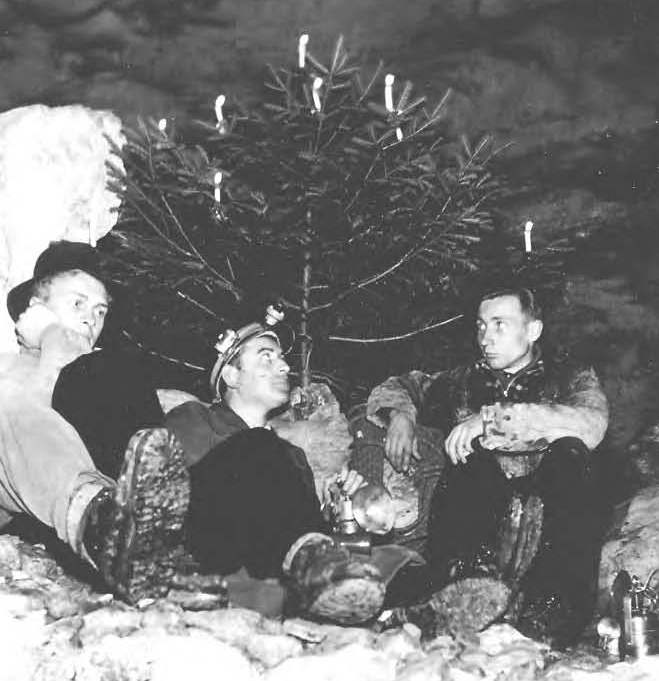
A legendary photograph from the founding years: Christmas in the Angerlloch, 25 December 1958
The young association did not have to wait long before publishing its first works, which were widely noted. One of the most influential figures in the association was Karl Thein, chair from 1965 to 1972. During his period of office, the club journal DER SCHLAZ was first published in May 1970 and has appeared regularly ever since. A major revision of the statutes in 1972 caused some internal disputes; since then, the association has been led by an expanded executive board elected for two years. In 1975, the association hosted the annual conference of the German Association of Cave and Karst Researchers.
In the 1980s a new dynamism emerged within the association, perhaps also encouraged by the plan to compile an "inventory" of cave exploration. This led to the publication of "Munchner Hohlengeschichte I" in 1982, a substantial work of 218 pages for its time. The association adopted a logo, and membership grew significantly from 101 people in 1981 to 208 in 1988. The later death of the long-serving chair Klaus Cramer in a mountain accident in 1993 marked a painful turning point. His commitment to the association remains unforgettable. Association activities continued to develop in many directions, including cave workshops, the long-term annual survey of the Eiskapelle beneath the east face of the Watzmann, the working group Cave-Religion-Psyche, and regular research camps in karst regions of the German and Austrian limestone Alps.
In September 2003, the one-hundredth issue of the club journal DER SCHLAZ was published.
In May 2004, the association celebrated its 50th anniversary by once again hosting the national annual conference, this time in Aschau im Chiemgau. The anniversary was crowned by the publication of an updated regional monograph of the working area, 433 pages long, appropriately titled Munchner Hohlengeschichte II.
The new millennium brought not only new research results, but also an expansion into neighbouring fields of knowledge. Numerous members of the association were heavily involved in the project Inntaler Unterwelten, a cross-border network of four show caves realised between 2010 and 2013 and awarded the Euregio prize of the EU. The association also played a leading role in the largest research project on biodiversity in Alpine caves to date, "Life in the Dark", which produced outstanding scientific findings about cave animals.
The past decade was initially overshadowed by disagreements and an unfortunate dispute over registry documents. Some members were so dissatisfied that they founded a second Munich cave association, Hohlenforschung Sudbayern e. V. (HFS), which developed very dynamically.
From 2016 onward, however, a welcome change in thinking took place within VHM. Prompted by a new executive board, both Munich associations decided to cooperate again and pool their strengths. In 2019 the two associations, each with around 100 members at the time, merged by formal merger agreement.
The result is a revitalised active association. In the course of this new beginning, a more modern logo was developed, accompanied by a new corporate design, an image brochure, and a new website. With currently more than 220 members, the highest number in its history, VHM is now one of the largest speleological associations in Germany and, with its library and cave register and above all the experience of its members, represents a key source of competence on karst and caves in southern Germany.
The Verein für Höhlenkunde München e.V. - Höhlenforschung in Südbayern has presented itself since then with a new logo. The valuable experience of long-standing members has been combined with the strong motivation of many younger members gained through the merger.
Together we pursue one goal: to advance the association in protecting karst landscapes and cave regions while also pushing our research forward.

Our activities
We meet regularly for social evenings. These are opportunities to plan new trips, get to know one another, exchange ideas, meet friends, or simply have a good time.
In spring and autumn we hold our climbing training, both in climbing gyms and outdoors.
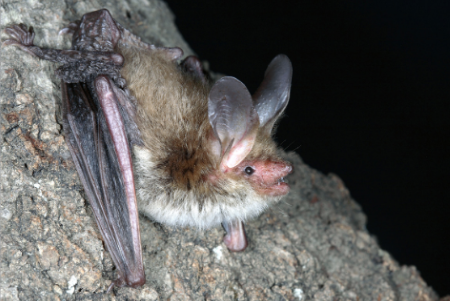
We carry out bat counts to monitor population development and work closely with the coordination office for bat protection in southern Bavaria under Dr Andreas Zahn and the Bavarian regional cave and karst association's bat protection section under Martin Harder. During the bat protection season, caves may not be entered from 1 October to 30 April each year.
During this period, we refrain from cave trips and focus on preparing research reports and our lecture evenings. These take place from October to March. With a changing programme of talks, we want to give our members and guests an insight into the work of the association.